A leather octopus sprawls across the marble of the Petit Palais. A mohair whale settles in among the museum’s bronzes, and a velvet Saint Bernard keeps watch over the room.
The animals came to Paris for Art Basel. Dollys & Beaux set the oversized textile sculptures of Cosima von Bonin inside the Petit Palais, the city’s fine arts museum on Avenue Winston Churchill. The galleries Gaga, Neu and Petzel staged the installation as part of the fair’s public program, open to anyone who walked in. For a few days in late October the museum kept a menagerie.
The creatures are not new. They first appeared in March at Loewe’s Fall-Winter 2026 show, a collection conceived by Jack McCollough and Lazaro Hernandez. The two designers invited von Bonin to bring her animals into the house. The octopus, the whale and the dog sat in the room while the clothes went past.
The runway
That show put the plush animals in the front row. They took seats and corners and watched the collection the way guests do, outsized and unblinking. Their presence carried into the clothes. Loewe reworked its Amazona 180 bag in their spirit, and several pieces borrowed the same soft, handmade logic.
The materials are the tell. Loewe is a leather house before it is anything else, and von Bonin’s octopus is built in leather, its arms slumping with real weight. The whale is mohair. The dog is velvet. Each creature is a lesson in a different craft, which is the language Loewe has spoken for years.
Von Bonin works out of Cologne. She has spent decades building stuffed creatures and fabric tableaux that treat the serious business of contemporary art with a straight face. Her animals look like toys scaled well past comfort. They are made to be read twice, once as a joke and once as something about longing and rest.
The museum
At the Petit Palais the menagerie moved in among the permanent collection. The whale lay down near marble figures that have held their poses for a century. The animals wore silk scarves and tartan, dressed for the visit. Plush against stone, the pairing made its own argument.
A fashion object changes when it leaves the catwalk. On the runway the creatures were props inside a designer’s set. In the museum they became sculpture, shown beside the canon and asked to hold their ground. The walk from one room to the other is the piece itself.
The octopus did not change. The room around it did, and that was enough.
The Splendid Edit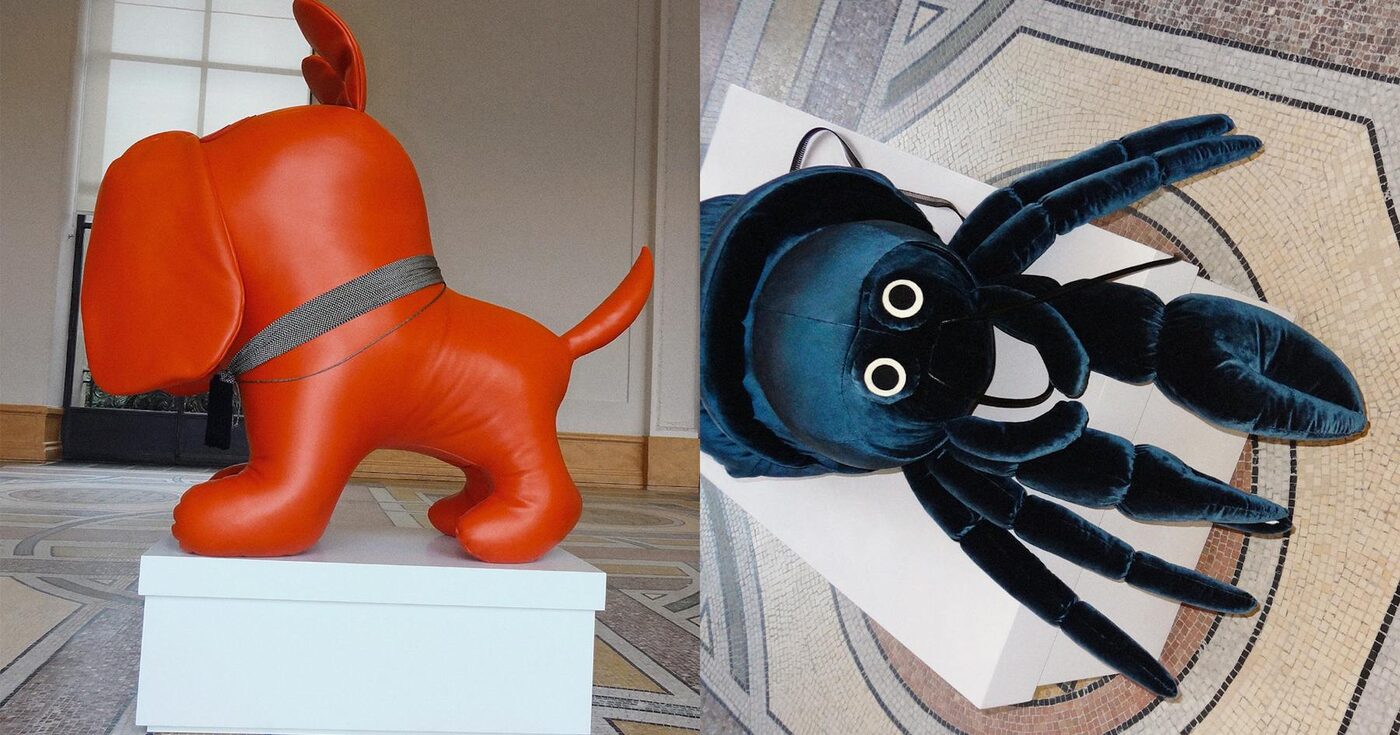
Dollys & Beaux at the Petit Palais, Paris. Courtesy of Loewe.
The exhibition asked little of the people who came to see it. There was no ticket and no long wall text explaining the joke. Children knew the animals on sight, before they knew the name Loewe. Visitors circled the whale and crouched to look under the octopus, and the marble figures kept their composure above the crowd.
Loewe was not alone that week. Across town, Louis Vuitton marked seven years of its Artycapucines bag at Art Basel Paris, and other houses tied their names to the fair. The overlap of commerce and art during the week is well established by now. What set the Petit Palais apart was that the fashion came in costume, as animals.
The house
Loewe has long treated craft as its subject. Under Jonathan Anderson the house built shows around ceramics and weaving and handed its annual prize to artists who work with their hands. McCollough and Hernandez, who now lead the house, kept the thread. Inviting von Bonin was a way of saying Loewe still reads fashion as one more material among many.
The Petit Palais stands a short walk from the Grand Palais, where Art Basel ran its main fair. For a few days the two buildings traded visitors. Collectors who came for paintings found a whale; people who came for the whale left thinking about Loewe. The creatures lay on the marble as though they had always lived there.