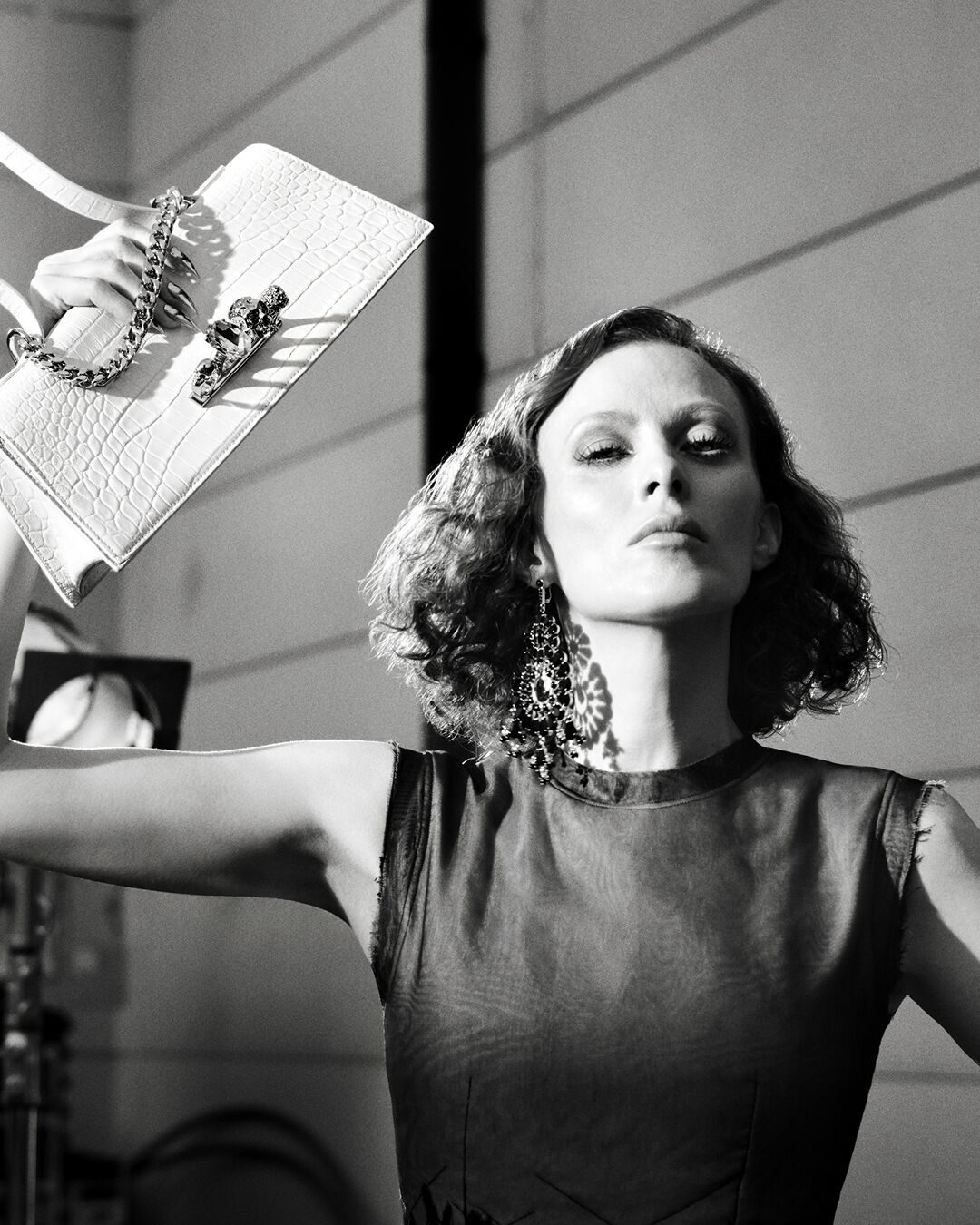
Four women look straight down the lens and hold it. McQueen released its autumn campaign on 29 July, and the whole thing runs on the pressure of being watched.
The campaign arrived as a still series and a film. Sean McGirr set the concept, Glen Luchford shot and directed both, and the result lands in the noir register the house has circled since McGirr took over in 2024. Karen Elson, Paloma Elsesser, Jacqui Hooper and Xiao Wen carry it. None of them blink.
The gaze
McGirr built the season on a single friction. There is the surface a person curates, and there is the reality underneath, and the campaign lives in the gap between the two. As the film moves, the fourth wall slips. Control gives way to something tactile. Desire, sexuality and strength move to the front.
Luchford knows the ground. He directed McGirr's debut campaign in 2024, and he comes back here as both photographer and director. The casting reads as a statement in itself. Elson has worked with McQueen for years, an enduring friend of the house, and McGirr sets her beside Elsesser, Hooper and Xiao Wen to link the house past and present in a single frame.
The film gives the cast room to hover between states. They could be sighing or startled, overwhelmed or emptied out, and Luchford leaves the question open. Set to Desire's Saturday, the sequence moves at the pace of a held breath. The refusal to resolve is the point, and the viewer does the work the models will not.
A face that refuses to perform is its own kind of tailoring. McQueen has always known the cut is only half the garment.
The Splendid EditThe clothes
The tension runs into the fabric. Savile Row tailoring, sharpened and precise, meets sculptural evening silhouettes in fluid silk georgette. Trompe l'oeil feather embroideries sit next to ornate lace, both asking to be touched. Structure and softness share the same look.
McGirr traced the collection to Hitchcock and to Todd Haynes' 1995 film Safe, in which Julianne Moore plays a woman made ill by her own surroundings. The reference reads in the clothes. Floral wallpaper prints and lace travel from the interior to the body. Bed jackets turn into eveningwear. Rose-quilted bombers land in icy hues.
A second movement pulls the collection out of the house and into the open. McGirr talks about the domestic set loose, the interior confinement giving way to expansive nature. Wallpaper blooms escape their frames. Lace and quilting, the stuff of bedrooms, get carried into daylight. The wardrobe ends up caught between shelter and exposure.
The details
Look closer and the treatments do the work. Changeant and pearlescent leather trench coats catch the light and shift with it. Silk mikado is sliced. Floral jacquards are crushed. An archival waterfall collar brings fluidity to the sharp lines, a McQueen signature bent slightly out of true.
Lace is not left on the surface. It sits trapped between layers of featherlight organza, intimate rather than decorative. Feather embroidery frames the dresses, worked from bullion, satin stitch and organza. Wild hand-embroidered flowers push out of 1960s silhouettes, pearlescent and sharpened to a point.
Colour stays low and cold across the season. Icy blues, bruised roses, the greys of an overcast interior. It is a palette borrowed from the films McGirr keeps naming, Hitchcock's measured dread and the antiseptic light of Safe. Even the embellishment reads as unease rather than ornament.
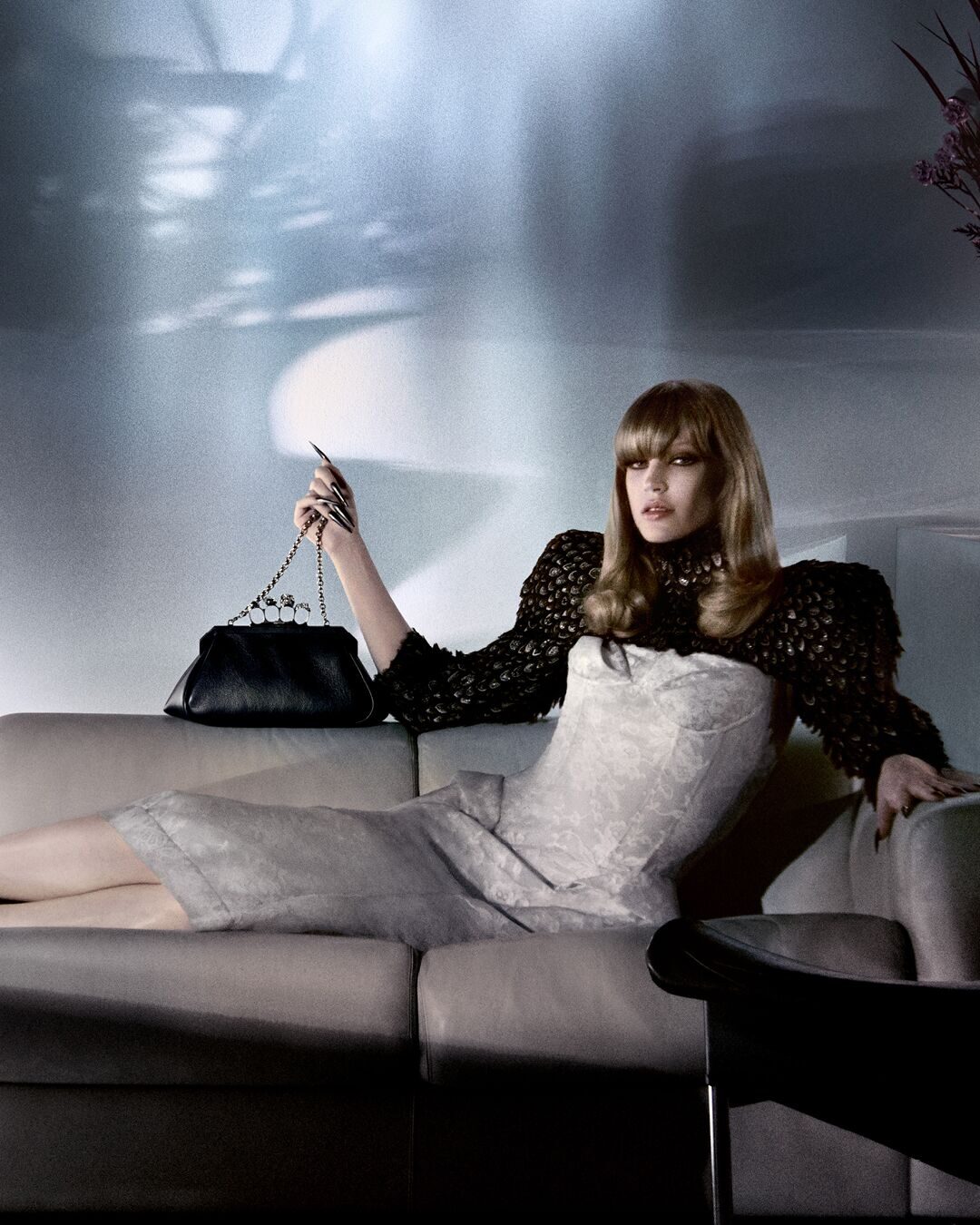
From the McQueen autumn/winter 2026 campaign, shot by Glen Luchford. Courtesy of Alexander McQueen
The campaign extends the runway rather than restating it. Tom Scutt designed the show's concept and production. A. G. Cook scored it. Ryan Chappell handled the movement. For the campaign, Luchford trades the theatre for a closer, quieter frame, and the soundtrack shifts to Desire's Saturday, released through Italians Do It Better. The styling stays with Camille Bidault-Waddington across both.
The house
McGirr's line on the season is plain. We are always on now, always watched, always performing, and the appetite has turned toward something intimate and real. The campaign answers that with faces that stay still and clothes that reward a second look. It is a long way from the London punk energy of his first outing, and closer to something interior.
London gets the next chapter in September. McQueen sits on the official schedule for spring/summer 2027, back among the houses that pull the crowds into the city. The autumn campaign is the register McGirr wants carried into that room, made in stills before it is made in a show.
He is three years into the house, past the debut and into the argument. This is the McQueen he wants: London tailoring, a noir mood, and women who meet the lens without softening. The collection reaches the boutiques through the autumn. The gaze is already everywhere.