The Opera national de Paris is putting its costume archive on the floor this weekend. Three days at the Bastille house, five thousand pieces, prices that start at two euros.
The pieces come out of a working wardrobe. Operas the company has produced, ballets the company has danced, garments cut for specific bodies on specific nights. The titles named on the bill include the operas Eugene Oneguine, Eliogabalo, and Les Capulets et les Montaigus, and the ballets Coppelia and Psyche. Each garment carries a date and a credit somewhere on its label.
The Opera has not opened a public sale of this size in years. Reservations went live on the 21st of May at 2:30 in the afternoon and the website moved through its allocation inside the same day.
The hall
The sale takes place in the modular hall under the Opera Bastille, at 110 rue de Lyon in the 12th arrondissement. The room is the back-of-house space the company uses for set builds and dress rehearsals, cleared this week and lined with racks. Admission to the floor costs ten euros, by reservation only on operadeparis.fr.
The choice of the Bastille hall is practical and also pointed. Garnier carries the public image of the company, all gilt and Chagall ceiling, but Bastille runs the heavy industry. The wardrobe department lives closer to the latter, in a sequence of rooms that very few outside the building ever see.
The price list
A ticket buys access. The garment is the second decision. Prices on the floor run from two euros at the low end to eight hundred at the top. The two-euro pieces are the everyday wardrobe, the working clothes that fill out a chorus or a crowd scene. The eight-hundred pieces are the principals, the constructed silhouettes that walked across the proscenium and held the lights.
What sits in between is the interesting part. A peasant blouse from a 1990s Coppelia. A doublet sleeve from an early run of Eliogabalo. A satin slipper with a name written inside the heel. The mid-range is where archivists, costume students, and the working stylists of Paris will spend their afternoons.
The slots
Friday opens with one window: 5 pm to 7 pm. Saturday and Sunday each run four windows, 10 am to 11:30, midday to 1:30, 3 to 4:30, and 5 to 7. The Opera has staggered the entries to keep the room moving and to protect the more fragile garments from a crush.
Each ticket is timed and named. The reservation site closed early registration the day it opened, and a second wave was released later in the week. By Friday morning, the front desk at the Opera was fielding calls from buyers asking whether the door price would hold.
A stage costume is a piece of fabric with a memory of who passed through it.
The Splendid EditTwo houses
The Opera national de Paris runs two stages. The Palais Garnier, the 1875 house at the foot of the Avenue de l'Opera, holds most of the ballet calendar. The Opera Bastille, the 1989 house on the Place de la Bastille, takes most of the lyric repertoire. One wardrobe operation supplies both, and one workshop builds for both.
The image carried with this piece is from the Palais Garnier during Paris Fashion Week earlier this year. The room itself, with its marble staircase and the gilded balconies, has hosted runway shows for decades. The same building's costume archive feeds the racks now lining the Bastille hall.
The market
A sale like this empties stockrooms and refreshes the budget that funds the next builds. The economics matter to a company running two production calendars at full pitch. The cultural side matters too. A costume on a private rack at home is the closest most people will ever get to the work of a Paris atelier.
Stylists already use Opera archives the way fashion houses use their own. Pieces have a half-life longer than a season, and a corset from a Verdi production reads as easily on a magazine page as anything cut new. The Bastille floor turns that practice into a public transaction for three afternoons.
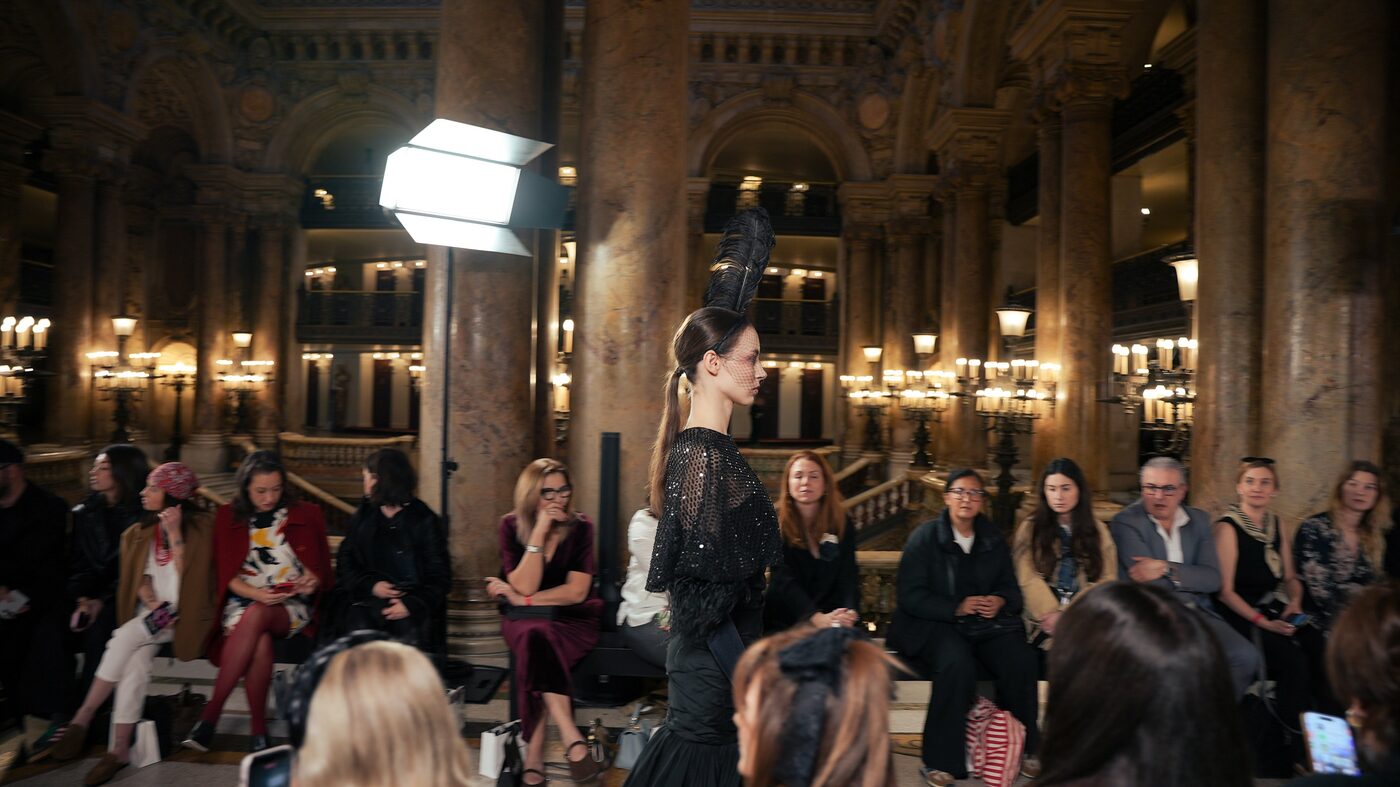
A look on the runway at the Palais Garnier during Paris Fashion Week, March 2026. Courtesy of Fashion PR Firm
The afternoon
The two-euro pieces will move first. The eight-hundred pieces will stay for the collectors who know what to look at. By Sunday night the racks will be light and the room will go back to what it does the rest of the year. Paris has not opened a sale like this in a long stretch, and a wardrobe department that has dressed a century of bodies on stage now has to count what it has left.
Photography courtesy of Fashion PR Firm.